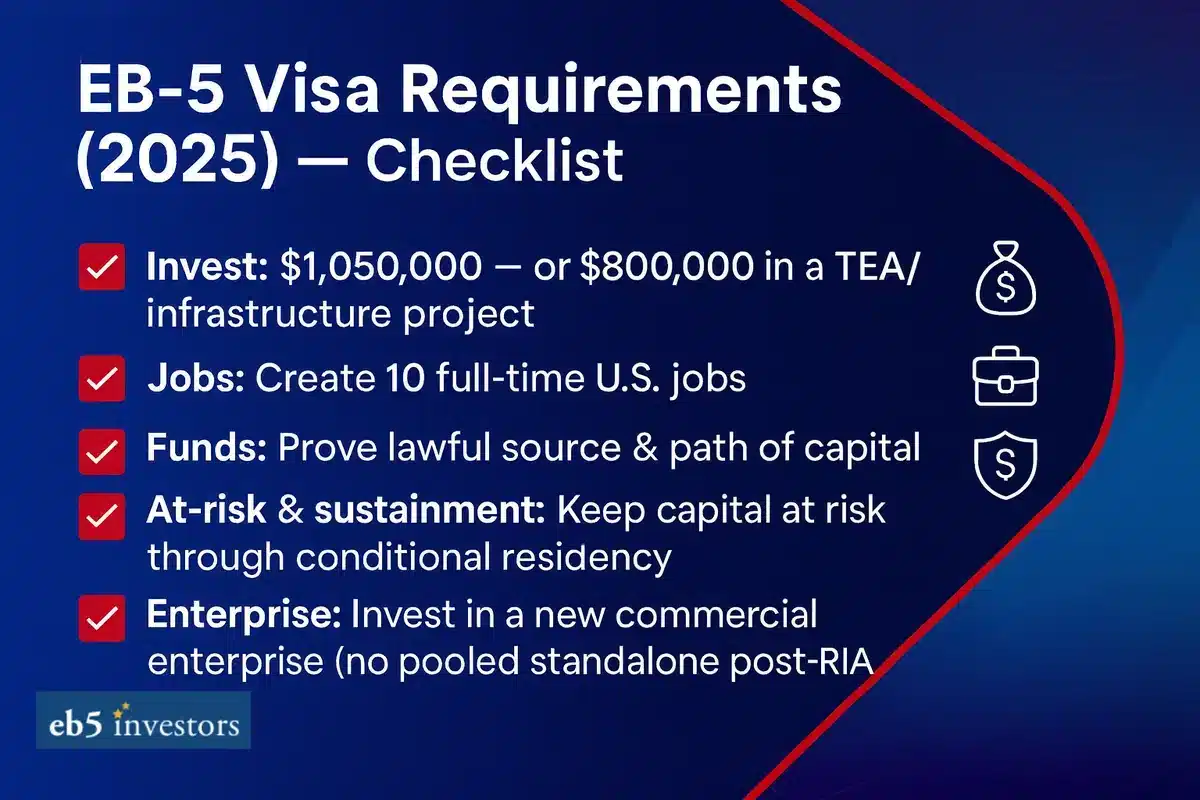
- Invest: $1,050,000 — or $800,000 in a TEA/infrastructure project
- Jobs: Create 10 full-time U.S. jobs
- Funds: Prove lawful source & path of capital
- At-risk & sustainment: Keep capital at risk at least two years from deployment
- Enterprise: Invest in a new commercial enterprise
- Process: File I-526E (or I-526), then I-829
Foreign investors must meet specific regulatory and United States Citizenship and Immigration (USCIS) requirements to obtain their green card through the EB-5 visa program. In general, the investor must meet capital investment amount requirements, job creation requirements, and ensure that the business receiving the investment qualifies for the EB-5 program, as specified under 8 C.F.R. § 204.6. EB-5 visa applicants, their spouse, and their children under 21 will obtain their permanent residency green card once all requirements have been successfully met and approved by the USCIS.
EB-5 Visa Requirements Summary
To qualify for an EB5 visa, applicants must:
- Invest: $1,050,000 in a U.S. business or $800,000 in a TEA (rural areas, high-unemployment zones, or infrastructure projects).
- Create Jobs: Generate 10 full-time jobs for U.S. workers within two years.
- Business Type: Invest in a for-profit U.S. enterprise.
Key EB-5 Deadlines in 2026 and 2027
The requirements themselves are stable, but three statutory dates fall in close succession and they are frequently confused with one another.
September 30, 2026 — grandfathering deadline
Under the grandfathering provision the RIA added to INA 203(b)(5), an investor who properly files Form I-526 or I-526E on or before September 30, 2026 is protected against a future lapse of the Regional Center Program. USCIS and the Department of State must continue to process and adjudicate the petition, and may not suspend visa allocation to its beneficiaries, even if Congress later fails to reauthorize the program. Petitions filed after that date carry no such protection.
January 1, 2027 — first inflation adjustment
The RIA requires the minimum investment amounts to reset for inflation every five years, with the first reset on January 1, 2027. The mechanism is statutory rather than discretionary: the standard amount is adjusted for cumulative CPI-U change measured from January 1, 2022, rounded down to the nearest $50,000, and the TEA minimum is then set at 75% of that adjusted figure.
USCIS has not yet published the new amounts. Industry estimates place the adjusted standard minimum between roughly $1.2 million and $1.25 million, and the TEA minimum between roughly $900,000 and $950,000. These are projections from published CPI-U data, not official figures. Our analysis of EB-5 investment thresholds and TEA risk ahead of 2027 covers the calculation in detail.
September 30, 2027 — current program authorization
The Regional Center Program is authorized through September 30, 2027. Further reauthorization is a matter for Congress.
These protect against different risks. Filing before September 30, 2026 protects adjudication of your petition. Filing before January 1, 2027 is what secures the current investment amount.
EB-5 Visa Investment
The EB-5 investment can take the form of cash, inventory, equipment, secured indebtedness, tangible property, or cash equivalents and is valuated based on U.S. dollar fair-market value.
For petitions filed on or after March 15, 2022, the minimum amounts are:
| Project type | Minimum investment |
|---|---|
| Standard project (non-TEA) | $1,050,000 |
| Targeted Employment Area — rural or high unemployment | $800,000 |
| Qualifying infrastructure project | $800,000 |
These figures have applied since the RIA took effect in March 2022 and remain in effect through the end of 2026.
Targeted Employment Area (TEA) Requirements
A Targeted Employment Area is either a rural area or an area that has experienced unemployment of at least 150% of the national average rate. Investing in a TEA reduces the minimum from $1,050,000 to $800,000.
Two points matter when preparing a petition:
- DHS designates TEAs, not states. The EB-5 Modernization Rule, effective November 21, 2019, ended the practice of state TEA designation and reserved that authority to DHS. The petition must itself contain sufficient evidence that the project location meets the TEA definition.
- Census tract aggregation is restricted. The same rule limited how tracts may be combined to qualify as a high-unemployment TEA, narrowing what had been a flexible practice.
TEA investments also draw on the RIA’s reserved visa categories, and rural set-aside petitions receive priority processing at USCIS. Our state-by-state rural TEA guide covers which areas currently qualify.
Lawful Source of Funds Requirements
The investor must demonstrate that the invested capital — including any administrative fee paid to a regional center — was obtained through lawful means, and must trace the path of those funds from acquisition through to deposit in the new commercial enterprise’s bank or escrow account.
Common sources and the documentation generally expected:
- Accumulated earnings. An accountant’s statement, bank statements, and tax returns covering at least the preceding five years. Bank statements should show capital accumulating over the relevant period. Employment should be evidenced through verification letters, labor contracts, and payroll records.
- Sale of an asset. Isolate the transaction and document the sale through receipts, contracts, stock ledgers, deeds, purchase agreements, and bank statements showing receipt of proceeds. The original acquisition of the asset must also be evidenced.
- Gift or personal loan. The lawful source of the donor’s funds must be shown and the gift traced from donor to recipient, with a supplementary statement explaining the circumstances. Personal loans require the same showing of lawful source and, conservatively, should be secured by the borrower’s personal assets.
- Company loan or profit distribution. Document the company’s operations and finances — formation documents, financial statements, tax records, business contracts and invoices — and establish that the company authorized the distribution or loan and that it was predicated on the investor’s equity interest.
Source-of-funds scrutiny has increased since the RIA took effect. Investors with layered or cross-border fund paths should expect to document every step rather than the endpoint, and typically engage an EB-5 immigration attorney specifically for this portion of the petition.
At-Risk Capital and the Sustainment Period
Capital must be placed genuinely at risk for the purpose of generating a return. A guaranteed return, or any arrangement functioning as debt owed back to the investor, defeats the requirement.
How long capital must remain invested changed under the RIA, and the distinction matters:
- Petitions filed on or after March 15, 2022. The capital must be expected to remain invested for not less than two years under INA 203(b)(5)(A)(i). Under current USCIS guidance that period generally begins when capital is contributed to the new commercial enterprise and placed at risk — not from the date of admission as a conditional permanent resident. These investors no longer need to sustain the investment throughout their entire period of conditional residence.
- Petitions filed before March 15, 2022. The earlier rule still applies. These investors must sustain the investment at risk throughout the full two-year period of conditional permanent resident status to be eligible for removal of conditions.
Because the sustainment clock now runs from deployment rather than from conditional residence, the redeployment obligations that historically affected long-waiting investors are substantially reduced for post-RIA filers. USCIS sets out this interpretation in agency guidance rather than regulation, so confirm current policy before relying on it.
EB-5 Job Creation Requirements
The USCIS requires that EB-5 investments result in the creation of 10 full-time jobs for U.S. workers. These jobs must be created within the two year period after the investor has received their conditional permanent residency. In some cases, the investor must be able to prove that their investment led to the creation of direct jobs for employees who work directly within the commercial entity that received the investment. However, the EB-5 investor may only have to show that 10 full-time indirect or induced jobs were created if the investment was made in a regional center. Indirect jobs are those created in businesses that supply goods or services to the EB-5 project. Induced jobs are jobs created within the greater community as a result of income being spent by EB-5 project employees.
A qualifying U.S. worker is a citizen, lawful permanent resident, asylee, or refugee. Jobs held by nonimmigrant workers or by the investor’s own family members do not count. How jobs may be counted depends on the structure:
| Direct investment | Regional center investment | |
|---|---|---|
| Direct jobs | Counted | Counted |
| Indirect jobs | Not counted | Counted |
| Induced jobs | Not counted | Counted |
| Evidence required | Business and payroll records | Economist report using accepted methodologies |
The ability to count indirect and induced jobs is the principal reason regional center investments substantially outnumber direct investments.
EB-5 Business Entities
There are several types of business entities in which an EB-5 visa applicant can invest. In general, the applicants can invest directly in a new commercial enterprise or through a regional center. New commercial enterprises are lawful for-profit entities that can take one of many different business structures. Such business structures include corporations, limited or general partnerships, sole proprietorships, business trusts, or other privately or publicly owned business structures. All new commercial enterprises must have been established after November 29, 1990.
However, older commercial enterprises may qualify if the investment leads to a 40-percent increase in the number of employees or net worth, or if an older business is restructured to such a degree that a new commercial enterprise results. In addition to individual business enterprises, EB-5 visa applicants can also through Regional Center projects, which may be more advantageous because the investor will not have to independently set up the EB-5 projects.
Investors also carry a management requirement. The investor must engage in the enterprise’s management, either through day-to-day managerial responsibility or through policy formation. In a regional center structure this is customarily satisfied through a limited partnership interest or LLC membership rights.
EB-5 Application Process: I-526E to I-829
- Select a project and subscribe. Conduct diligence, execute subscription documents, and deploy capital into the new commercial enterprise.
- File Form I-526E or I-526. Form I-526E is used for regional center investments; Form I-526 is for standalone direct investments. The petition establishes the qualifying investment, lawful source and path of funds, and the job creation framework.
- Obtain conditional residence. Once the petition is approved and a visa number is available, apply through consular processing abroad or, if lawfully present in the U.S. with a current priority date, through adjustment of status on Form I-485. Concurrent filing is available to investors from countries that are not retrogressed.
- File Form I-829. Form I-829 is filed during the 90-day window before the second anniversary of conditional residence, to remove conditions and obtain a permanent green card.
Two procedural changes in 2026 affect timing:
- First-in, first-out petition assignment. Effective March 30, 2026, USCIS generally assigns Forms I-526 and I-526E for review on a FIFO basis. I-526E petitions are assigned after a decision is issued on the associated Form I-956F, and rural set-aside petitions are prioritised to match anticipated fiscal-year rural visa usage.
- Shorter EAD validity. For applications filed on or after December 5, 2025, USCIS reduced the maximum Employment Authorization Document validity period from five years to 18 months for several categories, including EB-5 investors with pending adjustment applications. Expect more frequent renewal cycles.
See the steps of the EB-5 program for a fuller walkthrough.
EB-5 Filing Fees
USCIS filing fees for EB-5 forms have been subject to active litigation. In November 2025 a federal court set aside the April 2024 fee increases in Moody v. Mayorkas, and USCIS restored the earlier schedule. As of August 2026 the restored fees are in effect:
- Form I-526 / I-526E — $3,675, plus a separate $1,000 EB-5 Integrity Fund fee
- Form I-829 — $3,750
DHS published a proposed EB-5 fee rule on October 23, 2025, with comments closing December 22, 2025. The proposed amounts sit below the April 2024 levels but above the restored ones, and a final rule has not taken effect as of this update. Because these figures can change on short notice, confirm current fees on the USCIS fee schedule before filing. Regional centers additionally charge an administrative fee, commonly in the $50,000 range. Our full EB-5 cost breakdown covers government, legal, and project costs together.
Frequently Asked Questions
Who Can Apply for an EB5 Visa?
- Any foreign national from any country (except those restricted by U.S. sanctions).
- Must be at least 18 years old (minors can apply, but a legal guardian usually manages the investment).
- Must prove the investment funds were lawfully obtained (income, business profits, real estate sales, inheritance, etc.).
- Can apply individually or through a Regional Center (a USCIS-approved entity that pools investor funds for larger projects).
How Many EB-5 Visas Are Issued Annually?
The EB-5 visa program has an annual cap of 10,000 visas, including investors and their dependents, meaning only 3,000–4,000 actual investors receive visas each year. Each country is limited to 7% of the total visas (around 700 per year), and exceeding this limit results in a visa backlog (retrogression), leading to longer wait times, especially for high-demand countries like China, India, and Vietnam. Unused visas are redistributed to applicants from other countries. The 2022 EB-5 Reform and Integrity Act (RIA) reserved 32% of visas for investments in rural areas (20%), high-unemployment areas (10%), and infrastructure projects (2%). Countries with lower demand typically have shorter processing times.
What Is the Minimum EB5 Investment in 2026?
$1,050,000 for a standard project, or $800,000 for a project in a Targeted Employment Area or a qualifying infrastructure project. These amounts hold through the end of 2026 and are scheduled for their first statutory inflation adjustment on January 1, 2027.
How Long Must EB-5 Capital Stay Invested?
For petitions filed on or after March 15, 2022, capital must remain invested and at risk for at least two years, measured from when it is contributed to the new commercial enterprise. Investors who filed before March 15, 2022 must sustain the investment throughout their two-year period of conditional residence.
What Happens If I File After September 30, 2026?
You can still file, and the investment amount is unchanged through December 31, 2026. What is lost is the RIA grandfathering protection, which requires USCIS and the Department of State to continue adjudicating the petition and allocating visas even if the Regional Center Program lapses.
Do the 10 Jobs Have to Be Created Directly by My Investment?
Not necessarily. Direct investors may only count jobs created directly by the business, evidenced through payroll records. Regional center investors may count direct, indirect, and induced jobs, calculated by an economist using accepted methodologies.
Does an EB5 Investment Guarantee a Green Card?
No. Meeting the investment threshold is necessary but not sufficient. The petition must also establish lawful source of funds, a qualifying new commercial enterprise, and the required job creation. Petitions are denied for source-of-funds deficiencies and job creation shortfalls even where the capital was fully invested.
Can I Get My EB-5 Investment Back?
The EB-5 investment is an equity investment, not a loan, and must remain at risk for the sustainment period. Project documents typically contemplate a return of capital once defined conditions are met, but no return may be guaranteed — a guarantee would defeat the at-risk requirement and jeopardise the petition.
Interested in learning more about EB-5 visa requirements? Check out the following related articles from our contributing authors:
- EB-5 Investor Visa Requirements by Fredrick Voigtmann The EB-5 law, enacted in 1990, is intended to generate employment-creation, as well as foreign investment, in the United States… Fredrick Voigtmann
- EB-5 Applications by Julia Roussinova The EB-5 application for fifth employment-based preference immigrant visa category (“EB-5 visa”) was enacted by Congress in 1990… Julia Roussinova